Juicy Patterns Journal
Why most AI products attract users who don't stay
It's not the model. It's not the features. Here's what it actually is, and a ten-minute exercise to close the gap.
The AI era made one thing dramatically faster. Building.
Prototype in a weekend. Generate a landing page in hours. Ship a feature before your competitor finishes their stand-up.
What it didn't make faster is figuring out if you built the right thing for the right person. That's still discovery. And the gap between how fast you can build and how well you understand who you're building for — that's where your churn is hiding.
Most builders see the symptoms. Users sign up. Users leave. Conversion looks okay. Retention looks bad. The pitch works. The product doesn't stick.
This isn't a marketing problem. It's a foundation problem.
What signals actually do
Every product communicates value through signals. Features. AI model names. Performance benchmarks. Integration lists. Pricing pages. These aren't wrong. Signals are how products get seen.
But signals don't create value. They amplify it.
A signal on top of a strong value foundation attracts the right people and keeps them. The same signal on top of a weak foundation attracts people who leave when they don't find what they expected.
The question to ask about every signal you're using: What is this amplifying?
If you can answer in one concrete sentence about your user's actual world, you have a foundation. If you can't, you're pointing signals at nothing.
The Value Amplifier Model
Two dimensions. Four positions. One diagnostic.
Value foundation (vertical): Can you describe what changes for your user in their actual work without mentioning a feature, a model, or a metric? If yes, you have a foundation. If not, you don't yet.
Signal strength (horizontal): How visible, polished, and clear is your product to the outside world?
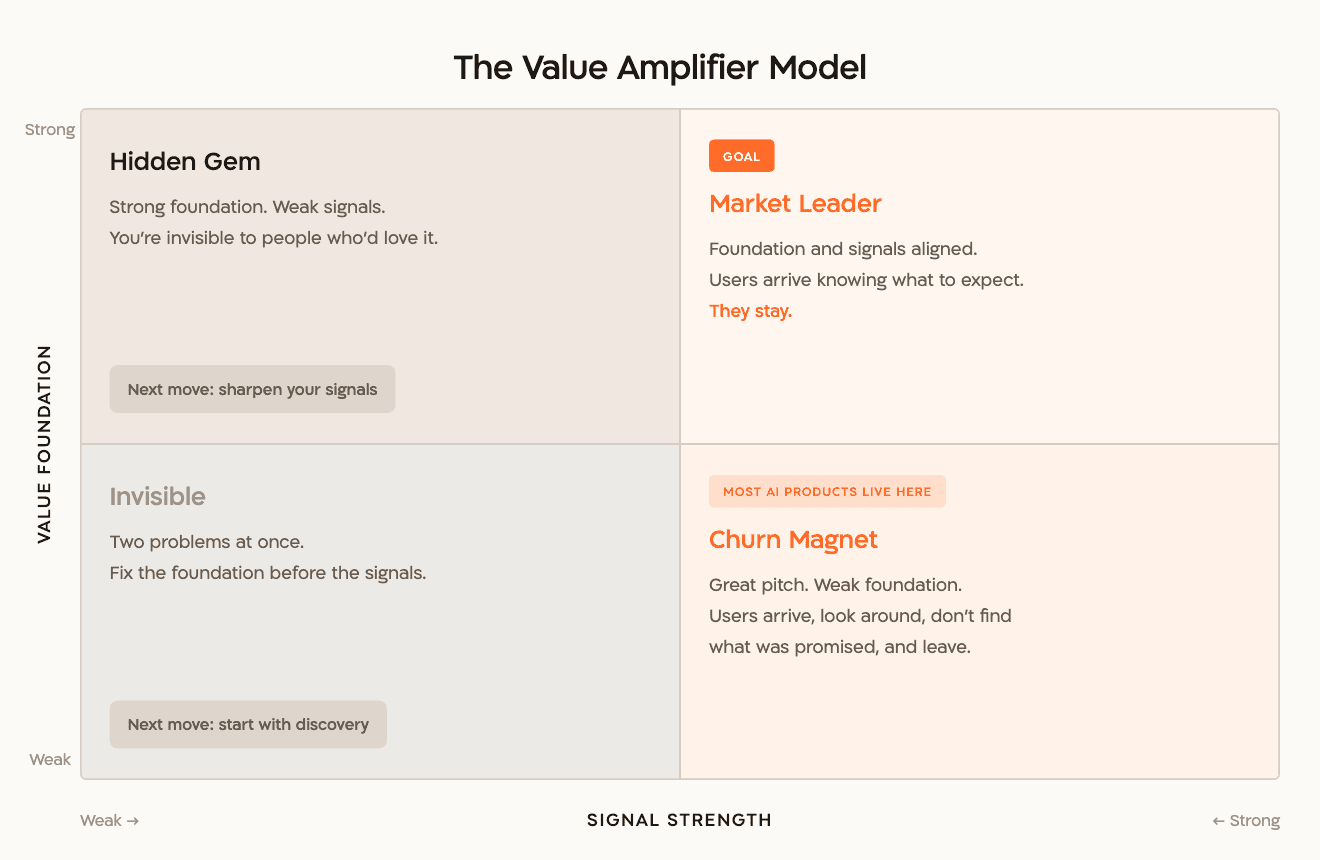
Most AI products built in the last two years are sitting in the Churn Magnet quadrant. Sharp signals. Weak foundation. Users arrive, look around, don't find what the signals promised, and leave.
The fix is not to dull the signals. It's to build what the signals are promising.
The 7 signals builders use instead of a foundation
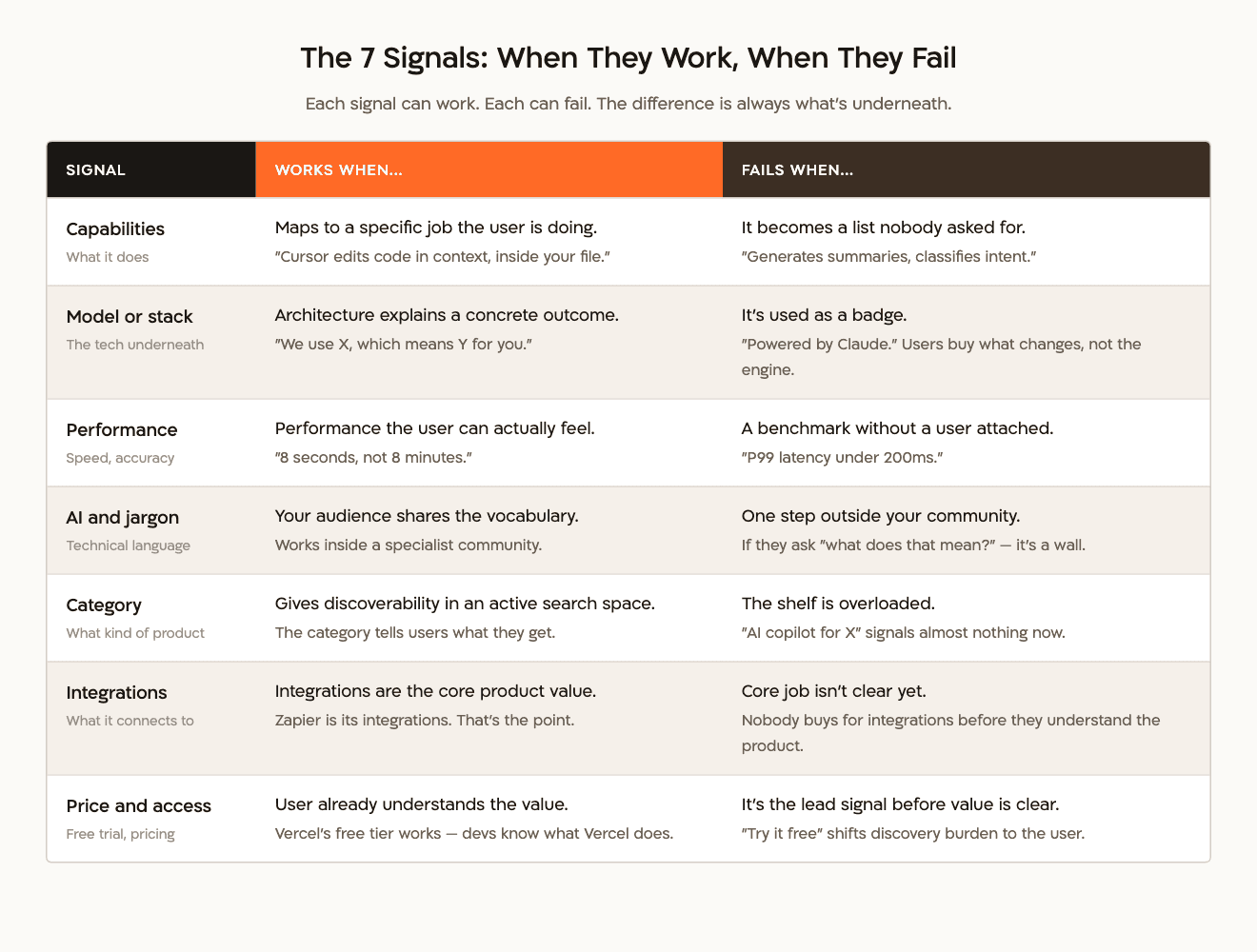
These are the seven most common signal types in software and AI products. Each one can work. Each one can fail. The difference is always the same: what's underneath it.
1. Capabilities
Works when the capability maps to a specific job your user is trying to do. "Cursor edits code in context, inside your file, without breaking surrounding lines" is a capability that maps to a job.
Fails when it becomes a list. "Generates summaries, extracts entities, classifies intent" is architecture, not value.
Try this: name the specific situation this capability changes. For whom, doing what, instead of what? If you can't answer, go deeper.
2. Model or stack
Works when the architecture explains a specific outcome the user cares about. "We use X, which means Y for you" earns its place.
Fails when it's a badge. "Powered by Claude." Users don't buy architecture. They buy what changes.
Try this: replace "built on X" with "that means Y for you." If Y is empty, the signal has nothing underneath it.
3. Performance metrics
Works when the performance produces something the user can feel. "8 seconds, not 8 minutes" earns its place.
Fails when it's a benchmark without a user attached. "P99 latency under 200ms" means nothing to someone who just wants the thing to work.
Try this: would your user notice this metric on a Tuesday afternoon?
4. AI and technical jargon
Works when your audience shares the language. Fails the moment they don't.
Try this: say it to someone one step outside your technical community. If they ask "what does that mean?" it's a wall, not a signal.
5. Product category
Works when it gives you discoverability in a space users are already searching.
Fails when the category is overloaded. "AI copilot for X" signals almost nothing now. The shelf is full.
Try this: does the category tell the user what they get, or just where to find you?
6. Integration breadth
Works when the integrations are the value. Zapier is its integrations. That's the product.
Fails when you lead with them before the core job is clear. Nobody buys a product for its integrations when they don't yet understand the product.
Try this: if you removed every integration, would the core value still hold? If yes, lead with that first.
7. Access model and pricing
Works when the user already understands the value and just needs to start. Vercel's free tier works because developers already know what Vercel does.
Fails when it's the lead signal. "Try it free" shifts the discovery burden to the user. They have to figure out the value themselves.
Try this: if a user tried for 14 days and left, was the problem the trial length or the value clarity?
What to do from each quadrant
Market leader: your signals and your foundation are aligned. The work now is staying there. Keep validating the foundation as the product evolves.
Hidden gem: the product works. The pitch doesn't show it. Your next move is signal work. Sharpen the demo. Tighten the positioning. Build one case study around the specific change your best users experience. You don't need to build more.
Churn magnet: this is the most common position for AI products right now. Your move is not to weaken the signals. It's to close the foundation gap. Run the exercise below.
Invisible: two problems at once. Start with the foundation, not the signals. A better pitch for a product without a value foundation just accelerates churn.
The exercise
Set a timer for ten minutes.
Answer this: What is different for your user on a Tuesday afternoon, one month after they started using what you built?
Write every answer you can think of. Don't filter yet.
Then cut any answer that mentions a feature, a model, a capability, or a metric.
What's left is your foundation.
If nothing is left, that's the most valuable thing you'll learn this week. You now know exactly where to focus.
Where to go from here
The signals aren't the problem. The discovery is.
If the exercise surfaced a clear answer: build your positioning around it. Your signals now have something real to amplify.
If it surfaced nothing: that's your next sprint. User interviews. Usage pattern analysis. A discovery session with your team. Map what actually changes for the users who stay.
Back to blog